Lot Coverage Calculation: What Every Homeowner Should Know
Lot coverage is one of the most frequently encountered zoning limits in residential permits — and one of the most often overlooked by homeowners until they’re mid-application. Understanding your lot coverage before you design an addition, pool, or accessory structure can save significant time and money.
Table of Contents
What Is Lot Coverage?
Lot coverage is the percentage of a lot’s total area covered by structures, impervious surfaces, or both. Zoning codes set maximum lot coverage limits to ensure adequate open space, manage stormwater runoff, and maintain neighborhood character.
How to Calculate Lot Coverage
Lot coverage is calculated as follows:
- 1. Calculate your lot area (from parcel data or survey)
- 2. Calculate the total footprint of all structures (house, garage, sheds, etc.)
- 3. Some codes include all impervious surfaces (driveways, patios, walkways)
- 4. Divide total covered area by lot area
- 5. Multiply by 100 for the percentage
- Example: 2,000 sq ft structures / 8,000 sq ft lot = 25% lot coverage
Typical Lot Coverage Limits
Limits vary by zoning district and city, but typical residential ranges:
- R-1 single family residential: 35–50% maximum
- R-2 low density residential: 40–60% maximum
- ADUs add to lot coverage — some cities count them separately
- Covered but open structures (pergolas) — some codes count, some don’t
What Counts Toward Lot Coverage?
This varies by code — always check your specific city. Common inclusions and exclusions:
- Almost always counted: Residential structure, garage, covered patio, shed
- Often counted: Driveway, walkways, pool decking
- Sometimes counted: Pool itself, uncovered patios, impervious gravel
- Usually excluded: Rooftop overhangs, underground elements, open decks in some codes
What to Do If You’re Over the Limit
If your proposed project would push you over the lot coverage limit:
- Reduce the size of the proposed structure
- Remove or downsize existing impervious surfaces
- Apply for a variance (public hearing, approval not guaranteed)
- Explore permeable paving options that may reduce impervious surface counts
Practical Permit Review Checklist
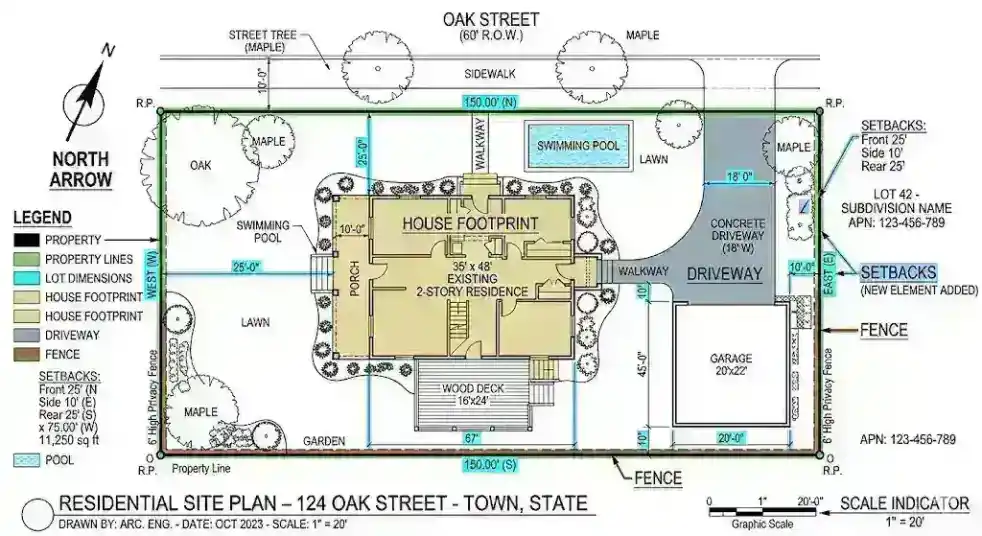
Before you submit your application, review the drawing as if you were the city plan reviewer. The plan should clearly show what already exists, what is being added, where the work will happen, and how the project fits within the property limits. For lot coverage calculation permit, the most important details are usually the property boundaries, accurate dimensions, setbacks, north arrow, project address, parcel information, and clear labels for existing and proposed work. These details help the reviewer understand the scope quickly and reduce avoidable correction comments.
- Confirm that the project address and owner information are correct.
- Check that proposed work is labeled separately from existing structures.
- Make sure setback distances are easy to read.
- Use consistent measurements across the site plan, floor plan, and any supporting drawings.
- Attach the plan in the format requested by your local building department.
How to Prepare Your Project Details
A better starting package usually creates a better final drawing. Gather your property address, a short description of the work, photos of the project area, rough measurements, and any instructions from the permit office. If you already have an old survey, plot plan, contractor sketch, or HOA document, include it during the order process. Even when those files are not perfect, they give the drafting team useful context and help prevent missing information.
For homeowners, the goal is not to create a complicated architectural package. The goal is to give the building department a clear, scaled, and easy-to-review drawing. That is why Lot Coverage Calculation: What Every Homeowner Should Know should focus on accuracy, simple labels, and the specific details your jurisdiction asks for. A clean plan is often easier for the reviewer to approve than a crowded drawing with unnecessary notes.
Common Mistakes to Avoid
Many permit delays happen because small details are missing. Common issues include using screenshots instead of scaled drawings, leaving out setbacks, showing old structures that no longer exist, forgetting easements, or submitting a plan that does not match the permit application. Another common mistake is using a generic plan when the city requires project-specific information. A permit-ready drawing should match your address, your project, and your local review requirements.
Ready to Get Your Permit-Ready Plans?
24-hour turnaround · Starting at $79 · Unlimited revisions · 100% money-back guarantee
Frequently Asked Questions
Does a driveway count toward lot coverage?
In many jurisdictions, yes. Impervious surfaces including driveways, concrete patios, and walkways count toward lot coverage in most residential codes. Some cities distinguish between “building coverage” (structures only) and “impervious coverage” (all hard surfaces).
Does a swimming pool count toward lot coverage?
The pool water surface may or may not count depending on your city’s code. Pool decking (the surrounding hardscape) almost always counts. Check your local ordinance.
What happens if my property already exceeds lot coverage limits?
Pre-existing non-conformities are generally allowed to remain, but you can’t expand the non-conformity. Any new addition that would increase coverage beyond the limit requires a variance.
Do I need to show lot coverage on my site plan?
Yes. Most building departments require lot coverage calculations on the site plan. We include coverage calculations automatically on all our site plans.